Cuttlefish
Cuttlefish or cuttles[1] are marineanimals of the order Sepiida. They belong to the class Cephalopoda, which also includes squid, octopuses, and nautiluses. Cuttlefish have a unique internal shell, the cuttlebone. Despite their name, cuttlefish are not fish but molluscs.
Cuttlefish Scientific classification
 Kingdom:AnimaliaPhylum:MolluscaClass:CephalopodaSuperorder:DecapodiformesOrder:Sepiida
Zittel, 1895Suborders and Families†Vasseuriina†Vasseuriidae†BelosepiellidaeSepiina†BelosaepiidaeSepiadariidaeSepiidae
Cuttlefish have large, W-shaped pupils, eight arms, and two tentacles furnished with denticulated suckers, with which they secure their prey. They generally range in size from 15 to 25 cm (6 to 10 in), with the largest species, Sepia apama, reaching 50 cm (20 in) in mantlelength and over 10.5 kg (23 lb) in mass.[2]
Cuttlefish eat small molluscs, crabs, shrimp, fish, octopus, worms, and other cuttlefish. Their predators include dolphins, sharks, fish, seals, seabirds, and other cuttlefish. The average life expectancy of a cuttlefish is about one to two years. Recent studies indicate cuttlefish are among the most intelligentinvertebrates.[3] Cuttlefish also have one of the largest brain-to-body size ratios of all invertebrates.[3]
The 'cuttle' in 'cuttlefish' comes from the Old English name for the species, cudele, which may be cognate with the Old Norse koddi ('cushion') and the Middle Low German Kudel ('rag').[4] The Greco-Roman world valued the cuttlefish as a source of the unique brown pigment the creature releases from its siphon when it is alarmed. The word for it in both Greek and Latin, sepia, now refers to a brown pigment in English.
Range and habitatEdit

S. mestus swimming (Australia)
The family Sepiidae, which contains all cuttlefish, inhabit tropical/temperate ocean waters. They are mostly shallow-water animals, although they are known to go to depths of about 600 m (2,000 ft).[5] They have an unusual biogeographic pattern: they are present along the coasts of East and South Asia, Western Europe, and the Mediterranean, as well as all coasts of Africa and Australia but are totally absent from the Americas. By the time the family evolved, ostensibly in the Old World, the North Atlantic possibly had become too cold and deep for these warm-water species to cross.[6] The common cuttlefish (Sepia officinalis), is found in the Mediterranean, and North and Baltic Seas, although it has been suggested populations occur as far south as South Africa. They are found in sublittoral depths, between the low tide line and the edge of the continental shelf, to about 180 m (100 fathoms)."[7] The cuttlefish is listed under the Red List category of "Least Concern" by the IUCN Red List of Threatened Species. This means that while there has been some over-exploitation of the marine animal in some regions due to large-scale commercial fishing, their wide geographic range prevents them from being too threatened. Ocean acidification, however, caused largely by higher levels of carbon dioxide emitted into the atmosphere, is cited as a potential threat.[8]
Anatomy and physiologyEdit
CuttleboneEdit
Main article: Cuttlebone

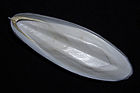
Top and bottom view of a cuttlebone, the buoyancy organ and internal shell of a cuttlefish
Cuttlefish possess an internal structure called the cuttlebone, which is porous and is made of aragonite. The pores provide it with buoyancy, which the cuttlefish regulates by changing the gas-to-liquid ratio in the chambered cuttlebone via the ventral siphuncle.[9]Each species' cuttlebone has a distinct shape, size, and pattern of ridges or texture. The cuttlebone is unique to cuttlefish, and is one of the features that distinguish them from their squid relatives. Jewellers and silversmiths traditionally use cuttlebones as moulds for casting small objects,[10] but they are probably better known as the tough material given to parakeets and other caged birds as a source of dietary calcium.
EyesEdit

The characteristic W-shape of the cuttlefish eye

Pupil expansion in Sepia officinalis
Cuttlefish, like other cephalopods, have sophisticated eyes. The organogenesisand the final structure of the cephalopod eye fundamentally differ from those of vertebrates such as humans.[11]Superficial similarities between cephalopod and vertebrate eyes are thought to be examples of convergent evolution. The cuttlefish pupil is a smoothly curving W-shape.[12][13]Although cuttlefish cannot see color,[14]they can perceive the polarization of light, which enhances their perception of contrast. They have two spots of concentrated sensor cells on their retina(known as foveae), one to look more forward, and one to look more backward. The eye changes focus by shifting the position of the entire lens with respect to the retina, instead of reshaping the lens as in mammals. Unlike the vertebrate eye, there is no blind spot, because the optic nerve is positioned behind the retina.
It has been speculated that cuttlefish's eyes are fully developed before birth, and that they start observing their surroundings while still in the egg. In consequence they may prefer to hunt the prey they saw before hatching.[15]
SuckersEdit
The suckers of cuttlefish extend most of the length of their arms and along the distal portion of their tentacles.
CirculationEdit
The blood of a cuttlefish is an unusual shade of green-blue because it uses the copper-containing protein haemocyaninto carry oxygen instead of the red, iron-containing protein haemoglobin found in vertebrates' blood. The blood is pumped by three separate hearts: two branchial hearts pump blood to the cuttlefish's pair of gills (one heart for each), and the third pumps blood around the rest of the body. Cuttlefish blood must flow more rapidly than that of most other animals because haemocyanin carries substantially less oxygen than haemoglobin.
InkEdit
See also: Cephalopod ink
Cuttlefish have ink, like squid and octopus species, which they use to help evade predators.[citation needed] This ink is stored inside an ink sac.
Venomosity and toxicityEdit
Some cuttlefish are venomous. The genes for venom production are thought to be descended from a common ancestor.[16]
The muscles of the flamboyant cuttlefish (Metasepia pfefferi) contain a highly toxic, unidentified compound[3] as lethal as that of a fellow cephalopod, the blue-ringed octopus.[17]
ReproductionEdit
Interacting cuttlefish


Male cuttlefish challenge one another for dominance and the best den during mating season. During this challenge, no direct contact is usually made. The animals threaten each other until one of them backs down and swims away. Eventually, the larger male cuttlefish mate with the females by grabbing them with their tentacles, turning the female so that the two animals are face-to-face, then using a specialized tentacle to insert sperm sacs into an opening near the female's mouth. The male then guards the female until she lays the eggs a few hours later.[18]
On occasion, a large competitor arrives to threaten the male cuttlefish. In these instances, the male will first attempt to intimidate the other fish. If the competitor does not flee, the male will eventually attack it to force it away, and the confrontation turns physical. The cuttlefish that can paralyze the other first, by forcing near its mouth, wins the fight and the female. Since there are, on average, four or five ( and sometimes as many as ten) males for every female, this kind of behavior is inevitable.[19]
Cuttlefish are indeterminate growers, so smaller cuttlefish always have a chance at finding a mate the next year, when they are bigger.[20] Additionally, cuttlefish unable to win in a direct confrontation with a guard male have been observed employing several other tactics to acquire a mate. The most successful of these methods is camouflage; smaller cuttlefish will use their camouflage abilities to disguise themselves as a female cuttlefish. Changing their body color, concealing their extra arms (males have four pairs, females only have three), and even pretending to be holding an egg sack, disguised males are able to swim past the larger guard male and mate with the female.[19][21][22]
CommunicationEdit
Cephalopods are remarkable for how quickly and diversely they can communicate visually. To produce these signals, cephalopods can vary four types of communication element: chromatic (skin coloration), skin texture (e.g. rough or smooth), posture and locomotion. Changes in body appearance such as these is sometimes called polyphenism. The common cuttlefish can display 34 chromatic, six textural, eight postural and six locomotor elements, whereas flamboyant cuttlefish use between 42 and 75 chromatic, seven textural, 14 postural, and seven locomotor elements. For the Caribbean reef squid(Sepioteuthis sepioidea), it is thought they have a "language" with up to 35 distinct signalling states, i.e. "words".[23][24]
Visual signals of the common cuttlefish[23]Chromic - lightChromic - darkTexturePostureLocomotorWhite posterior triangleAnterior transverse mantle lineSmooth skinRaised armsSittingWhite squarePosterior transverse mantle lineCoarse skinWaving armsBottom suctionWhite mantle barAnterior mantle barPapillate skinSplayed armsBuriedWhite lateral stripePosterior mantle barWrinkled first armsDrooping armsHoveringWhite fin spotsPaired mantle spotsWhite square papillaeExtended 4th armJettingWhite fin lineMedian mantle stripeMajor lateral papillaeFlattened bodyInkingWhite neck spotsMantle margin stripeRaised headIridescent ventral mantleMantle margin scallopingFlanged finWhite zebra bandsDark fin lineWhite landmark spotsBlack zebra bandsWhite splotchesMottleWhite major lateral papillaeLatero-ventral patchesWhite head barAnterior head barWhite arm trianglePosterior head barPink iridophore arm stripesPupilWhite arms spots (males only)Eye ringDark arm stripesDark arms
ChromaticEdit

This broadclub cuttlefish (Sepia latimanus) can change from camouflage tans and browns (top) to yellow with dark highlights (bottom) in less than one second.
Cuttlefish are sometimes referred to as the "chameleons of the sea" because of their remarkable ability to rapidly alter their skin color – this can occur within one second. Cuttlefish change color and pattern (including the polarization of the reflected light waves), and the shape of the skin to communicate to other cuttlefish, to camouflage themselves, and as a deimatic display to warn off potential predators. Under some circumstances, cuttlefish can be trained to change color in response to stimuli, thereby indicating their color changing is not completely innate.[25]
As well as being able to influence the color of light as it reflects off their skin, cuttlefish can also affect the light's polarization, which can be used to signal to other marine animals, many of which can also sense polarization.[26] It has been suggested that although cuttlefish (and most other cephalopods) lack color vision, high-resolution polarisation vision may provide an alternative mode of receiving contrast information that is just as defined.[27]
There are three broad categories of color patterns - Uniform, Mottle and Disruptive.[28] Some researchers have suggested that cuttlefish can display 12 to 14 patterns,[23] 13 of which have been categorized as 7 "acute" (relatively brief) and 6 "chronic" (long-lasting) patterns.[29] although other researchers suggest the patterns occur on a continuum.[28]
Patterns of the common cuttlefish[23]ChronicAcuteUniform lightUniform blanchingStippleUniform darkeningLight mottleAcute disruptiveDisruptiveDeimaticDark mottleFlamboyantWeak zebraIntense zebraPassing cloud
The color-changing ability of cuttlefish is due to multiple types of cell. These are arranged (from the skin's surface going deeper) as pigmented chromatophoresabove a layer of reflective iridophoresand below them, leucophores.[30][31]
ChromatophoresEdit
The chromatophores are a sac containing hundreds of thousands of pigment granules and a large membrane that is folded when retracted. There are hundreds of muscles radiating from the chromatophore. These are under neural control and when they expand, they reveal the hue of the pigment contained in the sac. Cuttlefish have three types of chromatophore; yellow/orange (the uppermost layer), red, brown/black (the deepest layer). The cuttlefish can control the contraction and relaxation of the muscles around individual chromatophores, thereby opening or closing the elastic sacs and allowing different levels of pigment to be exposed.[24] Furthermore, the chromatophores contain luminescent protein nanostructures; there are tethered pigment granules which modify light through absorbance, reflection, and fluorescence between 650 and 720 nm.[32][33]
For cephalopods in general, the hues of the pigment granules are relatively constant within a species but can vary slightly between species. For example, the common cuttlefish and the opalescent inshore squid (Loligo opalescens) have yellow, red and brown, the European common squid (Alloteuthis subulata) has yellow and red and the common octopus has yellow, orange, red, brown and black.[24]
In cuttlefish, activation of a chromatophore can expand its surface area by 500%. There may be up to 200 chromatophores per mm2 of skin. In Loligo plei, an expanded chromatophore may be up to 1.5 mm in diameter, but when retracted, it can measure as little as 0.1mm.[32][34][35]
IridophoresEdit
Retracting the chromatophores reveals the iridophores and leucophoresbeneath them, thereby allowing cuttlefish to use another modality of visual signalling brought about by structural coloration.
Iridophores are structures that produce iridescent colors with a metallic sheen. They reflect light using plates of crystalline chemochromes made from guanine. When illuminated, they reflect iridescent colors because of the diffraction of light within the stacked plates. Orientation of the schemochrome determines the nature of the color observed. By using biochromes as colored filters, iridophores create an optical effect known as Tyndall or Rayleigh scattering, producing bright blue or blue-green colors. Iridophores vary in size but are generally smaller than 1 mm. It has been shown that squid at least are able to change their iridescence. This takes several seconds or minutes and the mechanism is not understood.[36]However, iridescence can also be altered by expanding and retracting the chromatophores above the iridophores. Because chromatophores are under direct neural control from the brain, this effect can be immediate.
Cephalopod iridophores polarize light. Cephalopods have a rhabdomeric visual system which means they are visually sensitive to polarized light. Cuttlefish use their polarization vision when hunting for silvery fish (their scales polarize light). Female cuttlefish exhibit a greater number of polarized light displays than males and also alter their behavior when responding to polarized patterns. The use of polarized reflective patterns has led some to suggest that cephalopods may communicate intraspecifically in a mode that is "hidden" or "private" because many of their predators are insensitive to polarized light.[36][37][35]
LeucophoresEdit
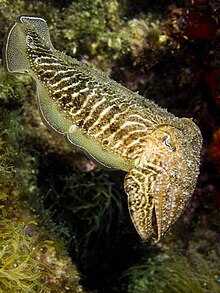
The white spots and bands on this cuttlefish are produced by leucophores.
Leucophores, usually located deeper in the skin than iridophores, are also structural reflectors utilizing crystalline purines, often guanine, to reflect light. Unlike iridophores, however, leucophores have more organized crystals that reduce diffraction. Given a source of white light, they produce a white shine, in red they produce red and in blue they produce blue. Leucophores assist in camouflage by providing light areas during background matching (e.g. by resembling light-colored objects in the environment) and disruptive coloration (by making the body appear to be composed of high-contrasting patches).[36]
The reflectance spectra of cuttlefish patterns and several natural substrates (stipple, mottle, disruptive) can be measured using an optic spectrometer.[36]
Intraspecific communicationEdit
Cuttlefish sometimes use their color patterns to signal future intent to other cuttlefish. For example, during agonistic encounters, male cuttlefish adopt a pattern called the Intense Zebra Pattern, considered to be an honest signal. If a male is intending to attack, it adopts a "dark face" change, otherwise, it remains pale.[38]
Females react to other females and their own reflection in a mirror with a display called Splotch. However, they do not use this display in response to males, inanimate objects or prey. This indicates they are able to discriminate same-sex conspecifics, which is noteworthy because humans are unable to make the same discrimination.[39]
Female cuttlefish signal their receptivity to mating using a display called Precopulatory Grey.[39] Male cuttlefish sometimes use deception toward guarding males to mate with females. Small males hide their sexually dimorphic fourth arms, change their skin pattern to the mottled appearance of females, and change the shape of their arms to mimic those of non-receptive, egg-laying females.[22]
Displays on one side of a cuttlefish can be independent of the other side of the body; males can display courtship signals to females on one side while simultaneously showing female-like displays with the other side to stop rival males interfering with their courtship.[40]
Interspecific communicationEdit
The Deimatic Display (a rapid change to black and white with dark ‘eyespots’ and contour, and spreading of the body and fins) is used to startle small fish that are unlikely to predate the cuttlefish, but use the Flamboyant Display towards larger, more dangerous fish[41] and give no display at all to chemosensory predators such as crabs and dogfish.[42]
One dynamic pattern shown by cuttlefish is dark mottled waves apparently repeatedly moving down the body of the animals. This has been called the Passing Cloud pattern. In the common cuttlefish, this is primarily observed during hunting and is thought to communicate to potential prey – “stop and watch me”[24] – which some have interpreted as a type of "hypnosis".
CrypsisEdit
Further information: Camouflage and Animal coloration

Juvenile cuttlefish camouflaged against the seafloor
External video Kings of Camouflage
– Nova documentary
Cuttlefish [43] are able to rapidly change the color of their skin[42] to match their surroundings and create chromatically complex patterns, despite their inability to perceive color, through some mechanism which is not completely understood.[43] They have been seen to have the ability to assess their surroundings and match the color, contrast and texture of the substrate even in nearly total darkness.[34]
The color variations in the mimicked substrate and animal skin are very similar. Depending on the species, the skin of cuttlefish responds to substrate changes in distinctive ways. By changing naturalistic backgrounds, the camouflage responses of different species can be measured.[44] Sepia officinalis changes color to match the substrate by disruptive patterning (contrast to break up the outline), where as S. pharanonis matches the substrate by blending in. Although camouflage is achieved in different ways, and in an absence of color vision, both species change their skin colors to match the substrate. Cuttlefish adapt their own camouflage pattern in ways that are very specific for a particular habitat. An animal could settle in the sand and appear one way, with another animal a few feet away in a slightly different microhabitat, settled in algae for example, will be camouflaged quite differently.[34]
Cuttlefish are also able to change the texture of their skin. The skin contains bands of circular muscle which as they contract, push fluid up. These can be seen as little spikes, bumps or flat blades. This can help with camouflage when the cuttlefish becomes visually similar to objects in its environment such as kelp or rocks.[34]
DietEdit

Video of S. mestus in Sydney waters, hunting and catching prey
While the preferred diet of cuttlefish is crabs and fish, they feed on small shrimp shortly after hatching.[45]
Cuttlefish use their camouflage to hunt and sneak up on their prey.[46] They swim at the bottom, where shrimp and crabs are found and shoot out a jet of water to uncover the prey buried in the sand. Then when the prey tries to escape, the cuttlefish open their eight arms and shoot out two long feeding tentacles to grab them. Each arm has a pad covered in suckers which grabs and pulls prey toward its beak, paralyzing it with venom before eating it.[45] In order to achieve a hypnotic effect and stun prey before catching them, cuttlefish are also known to change color rapidly.[citation needed]
TaxonomyEdit
 Wikispecies has information related to: Sepiida


Video of a cuttlefish in its natural habitat
Over 120 species of cuttlefish are currently recognised, grouped into five genera. Sepiadariidae contains seven species and two genera; all the rest are in Sepiidae.
Class CephalopodaSubclass Nautiloidea: nautilusSubclass Coleoidea: squid, octopus, cuttlefishSuperorder OctopodiformesSuperorder DecapodiformesOrder BoletzkyidaOrder Spirulida: Ram's horn squidOrder Sepiida: cuttlefishSuborder VasseuriinaFamily VasseuriidaeFamily BelosepiellidaeSuborder SepiinaFamily BelosaepiidaeFamily SepiadariidaeFamily SepiidaeOrder Sepiolida: bobtail squidOrder Teuthida: squid

The common cuttlefish (Sepia officinalis) is the best-known cuttlefish species

The giant cuttlefish, (Sepia apama) is the largest cuttlefish species

Hooded cuttlefish (Sepia prashadi)

Engravings by the Dutch zoologist Albertus Seba, 1665–1https://en.m.wikipedia.org/wiki/Cuttlefish